2026 Best Aluminum Composite Panel Types for Global Buyers
Choosing the right Aluminum Composite Panel in 2026 requires more than comparing prices, colors, or thicknesses. Global buyers must examine core composition, coating durability, fire performance, fabrication quality, and project location. A panel that performs well on a dry coastal façade may fail under intense heat, heavy rain, or repeated freeze-thaw cycles.
Façade-engineering expert Dr. John Straube has emphasized, “A wall is a system, not a material.” This principle remains essential for Aluminum Composite Panel selection. The panel, sealant, fasteners, insulation, subframe, and installation method must work together. Ignoring one detail can create staining, movement stress, water penetration, or premature coating failure. Small details matter.
This guide reviews the leading panel types for international buyers, including polyethylene-core, fire-retardant, mineral-core, and aluminum honeycomb options. It also compares PVDF, FEVE, anodized, and specialty finishes. Each type offers different advantages in weight, stiffness, appearance, maintenance, and safety performance. There is no universal winner.
That assumption is too simple.
Real projects often expose weaknesses that product brochures conceal. A glossy finish may show scratches near busy entrances. A low-cost core may complicate approval in high-rise construction. An imported panel may also lack consistent test documentation or clear batch traceability. Buyers should request current technical data, independent certificates, sample panels, and installation references before signing contracts. Standards differ between markets, and compliance should never be assumed. This overview provides a practical starting point, while final decisions should involve qualified façade engineers and local authorities.
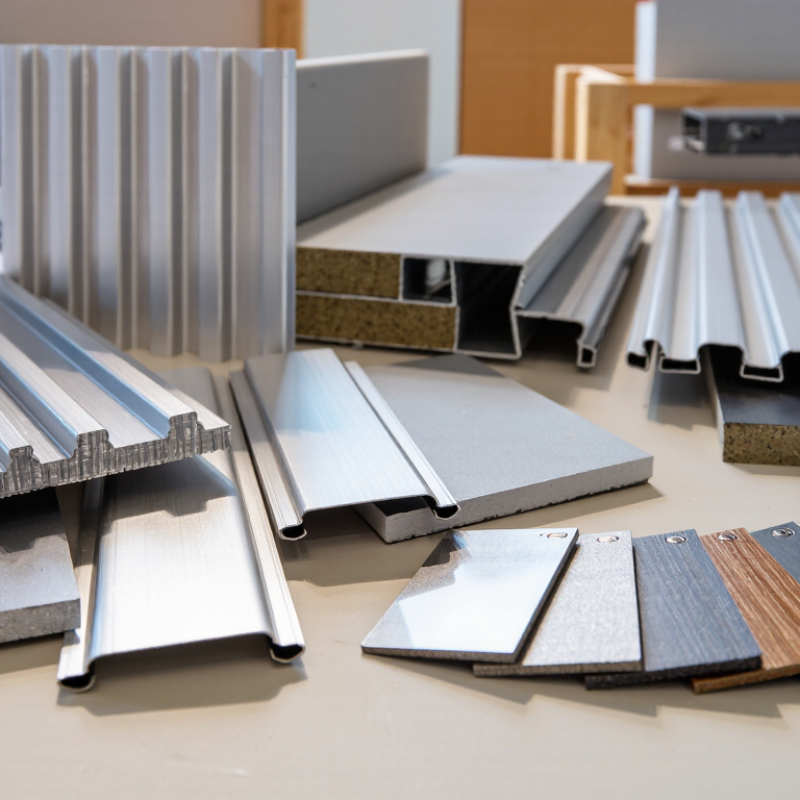
Aluminum Composite Panel Types: PE, PVDF, FEVE, and Fire-Retardant Cores
For global buyers, aluminum composite panels differ mainly by coating and core performance. PE-coated panels suit interior walls, retail displays, and sheltered areas with limited weather exposure. PVDF coatings provide stronger resistance to ultraviolet light, moisture, and color fading. They are common for demanding exterior façades. FEVE coatings offer excellent gloss, deeper color, and good outdoor durability, especially when appearance matters. However, performance depends on coating thickness, surface preparation, and manufacturing quality.
Fire-retardant panels use mineral-filled cores that reduce flame spread and smoke development. They can support safer façade designs, but they are not automatically non-combustible. Buyers should request complete fire-test reports, core specifications, and installation limitations. In project reviews, small details often cause problems. Incorrect joint gaps, weak fasteners, or poor edge sealing can reduce real-world performance. The panel may be excellent. The installation may not be.
Tips: Match the coating to exposure, not only price. Ask for coating thickness, color-retention data, and warranty conditions. Confirm test standards accepted in the destination market. For coastal buildings, inspect corrosion resistance and sealant compatibility. For tall façades, involve a qualified façade engineer before ordering. A sample panel should be checked under daylight, because digital colors can mislead. Some buyers overlook this. That mistake is expensive.
2026 Best Aluminum Composite Panel Types for Global Buyers
Typical architectural coating thickness ranges by aluminum composite panel type
How to read this chart: PE coatings are commonly specified at approximately 18–25 μm, while PVDF and FEVE systems are commonly specified at approximately 25–35 μm for architectural applications. A fire-retardant core is a separate core construction rather than a coating type; its fire classification must be verified from the complete tested panel assembly and the applicable local standard.
Global Fire Standards: EN 13501-1 A2 and ASTM E84 Class A ACPs
For global buyers, fire classification should guide ACP selection, not only price or surface finish. Mineral-core aluminum composite panels can target EN 13501-1 A2-s1,d0. A2 means limited combustibility, while s1 indicates low smoke production and d0 means no flaming droplets. It does not mean completely non-combustible. Read the certificate carefully.
ASTM E84 Class A is different. The standard measures surface burning, with a flame-spread index of 0–25 and a smoke-developed index of 0–450. A Class A ACP may still contain a combustible core.
Therefore, Class A and EN A2 should never be treated as identical ratings. The product report, core construction, thickness, coating, and tested assembly all matter. Details matter.
NFPA Research recorded 1,504,500 fires in the United States during 2023, showing why façade fire performance deserves serious verification. Buyers should request laboratory reports, field-of-application limits, and batch traceability before approval. EN 13501-1:2018 and ASTM E84 provide useful benchmarks, but neither replaces full façade-system assessment. Check cavity barriers, insulation interfaces, joints, and fixing details. A panel can pass alone yet perform differently within a complete wall. That uncomfortable gap is often overlooked.
Performance Data: 3–4 mm Thickness, 0.5 mm Aluminum Skin, and PVDF Coatings
For global buyers, 3–4 mm aluminum composite panels offer a practical balance between stiffness, weight, and installation control. A 0.5 mm aluminum skin usually resists dents better than thinner skins during transport and handling. It also supports cleaner routing around window corners. However, thickness alone does not prove structural performance. Core density, bonding quality, panel span, and wind pressure still matter.
PVDF coatings are widely selected for façades exposed to strong sunlight, humidity, and temperature changes. AAMA 2605 qualification evaluates color retention, chalking, adhesion, and surface durability under accelerated and outdoor exposure. The International Aluminium Institute reports that recycled aluminum requires roughly 5% of the energy used for primary aluminum production. That finding supports responsible material selection, but coating performance remains a separate question. A durable panel can still fail if its edges absorb moisture.
In project testing, buyers should request coating thickness, gloss level, color-difference data, and salt-spray results. ASTM D2244 helps measure visible color change, while ASTM D4214 evaluates chalking. PVDF is not automatically superior in every climate. Coastal salt, pollution, and poor cleaning routines can shorten service life. I would also question any catalog claim without full test conditions. A 3 mm panel may perform well on a short span, yet feel too flexible on a large façade. Real performance depends on the whole assembly, not one specification.
Choosing ACP by Climate, Building Code, Application, and Lifecycle Cost
2026 Best Aluminum Composite Panel Types for Global Buyers
Choosing ACP by climate, building code, application, and lifecycle cost requires more than comparing surface finishes. In coastal cities, salt exposure can accelerate corrosion around cut edges and fixings. Specify suitable coatings, sealed joints, and regular inspections. In hot regions, solar gain and panel movement deserve attention. In cold climates, confirm sealant flexibility and façade drainage.
No panel wins everywhere.
Building codes should guide the core selection. Fire-rated or mineral-filled cores may suit high-rise façades, transport facilities, and public buildings. However, performance must be verified through project-specific testing. Check reaction-to-fire classification, wind resistance, impact strength, and thermal expansion.
The Global Status Report for Buildings and Construction 2024 reports that buildings consume about 32% of global energy and produce roughly 34% of global carbon emissions. Therefore, insulation continuity and airtight detailing can matter more than panel appearance.
Tips: Request test reports, declarations of performance, coating data, and installation records. Compare expected service life, cleaning frequency, replacement access, and disposal costs.
The International Aluminium Institute states that recycled aluminium uses about 5% of the energy required for primary aluminium production. That figure supports stronger recycling plans, but transport and core separation still need review.
A cheaper panel can become expensive after one damaged section. I would not ignore that risk.