Best Cement Types to Use at Home in 2026?
Choosing cement at home in 2026 starts with the job, not the bag color. A patio slab, a fence post, and a small indoor repair face different demands. Moisture, temperature swings, setting time, and the product’s instructions all matter. So does the base beneath the work. A strong mix cannot fix poor preparation.
Concrete materials researcher Dr. Kimberly Kurtis of Georgia Tech offers a useful perspective. The following is a paraphrase, not a verbatim quotation: “Choose cement for the exposure and performance you need, not just the label.” That principle helps homeowners compare ordinary Portland cement, blended cement, and specialty products without assuming one type suits every project. Check the manufacturer’s stated uses, water requirements, and curing guidance. For a damp basement patch, for example, a product rated for that repair is more relevant than a general-purpose bag chosen by habit.
This guide looks at common cement types, their practical strengths, and where they may fall short. It also separates cement from concrete, terms often mixed up on store shelves. Small jobs can look simple. They are not always forgiving. A rushed mix or skipped curing can leave a rough surface or weak edge. Even careful advice has limits: local weather and site conditions change what works. Use the product label, and seek qualified help when the repair affects structural safety.
Understanding Cement Types and Their Key Properties
Best Cement Types to Use at Home in 2026?
Understanding Cement Types and Their Key Properties
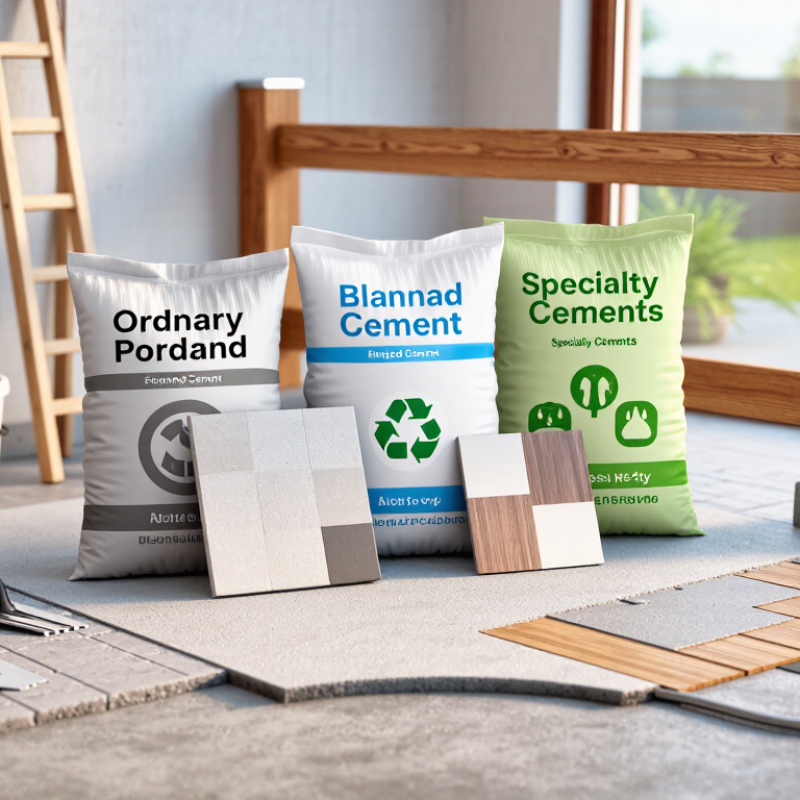
Cement is the powder that binds concrete; it is not concrete itself. For routine home repairs, ASTM Type I/II Portland cement is commonly suitable when the project has no unusual exposure or strength demands. Type III develops strength faster, which can help in cold weather or time-sensitive repairs. Type V offers high sulfate resistance for certain soil conditions. The numbering is easy to misread. Type V does not simply mean “stronger.”
Blended cements, covered by ASTM C595, may combine Portland cement with materials such as slag or pozzolans. These blends can affect early strength, heat development, and long-term durability. Check the product’s technical data sheet and the project specification; local soil and moisture conditions matter. A porch slab exposed to de-icing salts needs different consideration from a dry indoor patch. The label alone is not enough.
Scale matters, too. The USGS Mineral Commodity Summaries 2025 estimates U.S. cement production at about 86 million metric tons in 2024, reflecting cement’s widespread use, not a guarantee that one type suits every job. The International Energy Agency reports that cement production contributes roughly 7% of global energy-related CO₂ emissions. Lower-carbon blended options can reduce impact, but curing and performance still deserve attention. For structural work, follow the engineer’s specifications rather than choosing by bag color or price.
Best Cement Types to Use at Home in 2026? Understanding Cement Types and Their Key Properties
Clinker content in common EN 197-1 cement families (by mass)
For many routine home projects, general-purpose Portland cement (CEM I) or a suitable blended cement (CEM II) may be appropriate. Lower clinker content does not by itself indicate better performance: setting time, strength development, exposure conditions, and the product’s declared specification matter. Follow the project specification and manufacturer’s instructions.
Comparing Common Cement Options for Home Projects
For most home projects, ordinary Portland cement Type I/II is the practical baseline. Under ASTM C150/C150M, it suits general concrete work, such as setting fence posts or patching a small slab.
Type III develops strength faster, which can help when temperatures are low or repairs need earlier use. It is not automatically better for a weekend job; rapid setting leaves less time to place and finish the mix.
Type V offers increased sulfate resistance, but most household projects do not need it unless soil or water conditions warrant professional advice.
Blended hydraulic cement, covered by ASTM C595/C595M, can also suit general construction and may reduce clinker content. Actual performance depends on the specific blend and product instructions. Masonry cement is designed for mortar, not structural concrete. Not interchangeable.
The U.S. Geological Survey’s Mineral Commodity Summaries 2025 estimated U.S. cement production at about 90 million metric tons in 2024, showing how widely used the material remains—not which type fits a particular repair.
For a cracked step, check whether the bag specifies patching or repair use, and follow its water ratio. Too much water can weaken the result. I would also check the expected temperature and curing time; those details are easy to overlook when comparing bags.
Matching Cement Types to Indoor and Outdoor Applications
Choosing cement for a home project starts with the material around it. Cement is an ingredient, not the finished concrete or mortar. For an indoor floor repair, a suitable repair mix can fill a shallow chip; a thick pour needs a concrete mix designed for that depth. Keep dust down, protect nearby surfaces, and follow the product’s water and curing instructions. More water may make mixing easier, but it can weaken the finished surface.
Brick and block joints call for masonry mortar, not straight cement paste. Interior walls are usually sheltered from rain and freezing, so the main concerns are joint strength and compatibility with the existing masonry. A mortar that is too hard can damage softer bricks. Small detail, big consequence. For damp basements, hydraulic repair cement may help with specific leaks, but it will not fix the source of water pressure.
Outdoor work faces weather. Walkways and steps need concrete suited to the expected load and local freeze-thaw exposure; air entrainment is a mix feature worth checking in cold climates. Rapid-setting cement can be useful for a small repair, though it leaves little working time. Read the label carefully. Soil chemistry, drainage, and curing conditions can change the right choice, and a quick visual match is not always enough. I would verify the existing material before patching, especially on older masonry.
Choosing Cement Based on Climate, Strength, and Setting Time
Best Cement Types to Use at Home in 2026?
Choosing Cement Based on Climate, Strength, and Setting Time
Climate changes cement performance, but the exposure around your home matters more than the month. In hot, dry weather, wind and sun can pull moisture from fresh concrete quickly. ACI 305R identifies evaporation rates near 0.2 pounds per square foot per hour as a point for protective measures. Shade, windbreaks, and timely curing can help. That detail is easy to overlook.
For general repairs, ASTM C150/C150M classifies Type I cement for general use, Type II for moderate sulfate resistance, and Type III for high early strength. Type III can help when cooler weather slows strength gain, but faster early strength does not mean every project needs it. For sulfate-rich soil, consider Type V only after checking soil conditions. In freeze-thaw areas, air entrainment is a concrete mix feature, not a cement type; ACI 318 addresses it for exposed concrete.
Setting time also shifts with temperature, water content, and handling. ASTM C191 measures cement setting time under controlled laboratory conditions, so a published figure may not match a windy driveway. I would verify the mix with a small test batch. It is less convenient, but often more useful than guessing from the bag.
Checking Quality Standards and Safe Handling Practices
For home projects in 2026, cement quality starts with the label, not the bag’s appearance. Check that the product type suits the job, such as concrete work or masonry, and that its stated standard meets requirements where you live. Look for a readable batch number, production date, and intact, dry packaging. Looks can mislead. A smooth bag proves little.
Ask for the product and safety data sheets when details are unclear. Compare setting guidance, storage limits, and strength information with your project needs; different cement types do not behave alike. A hard lump inside a bag can signal moisture exposure, so avoid using it for work where performance matters. It is tempting to treat color as a quality test. That shortcut deserves skepticism.
Before opening a bag, work outdoors or with good ventilation. Wear sealed eye protection, gloves, long sleeves, and a suitable particulate respirator. Cement dust can irritate lungs, while wet cement can cause serious skin burns. Keep it off skin. If contact occurs, rinse promptly with clean water and remove contaminated clothing. Lift bags close to your body, keep children away, and follow the safety sheet for storage and cleanup. Do not sweep dry dust into the air; damp cleanup is safer.